As Britain prepares to stage the world premiere of Sir John Tavener’s final opera, Krishna, former monk and translator Andrew Horn explores why sacred and mystical traditions continue to resonate in an age of artificial intelligence, technological acceleration and growing secularisation.
When Grange Park Opera stages the world premiere of Sir John Tavener’s final opera, Krishna, this June, audiences will encounter something many cultural commentators assumed modernity had left behind: a large-scale artistic work devoted unapologetically to the sacred.
For decades, we have been told that technological progress, scientific understanding and growing secularisation would steadily reduce the influence of spiritual thought. Yet the prediction has never quite come to pass. The forms may change, institutions may rise and fall, but human beings continue to ask the same questions that they always have. Why are we here? What gives life meaning? What lies beyond the limits of ordinary experience?
The persistence of such questions helps explain why sacred and mystical traditions continue to attract artists, even in an age increasingly dominated by algorithms, AI and digital immersion.
Tavener, one of Britain’s most revered modern composers, understood this perhaps better than most. Throughout his career, he pursued music that sought to point beyond itself. His work was marked by a restless search for transcendence, drawing inspiration from a variety of religious and spiritual traditions. In choosing Krishna as the subject of his final opera, he turned to one of the world’s richest and most enduring sacred narratives.
Part of what makes this interesting is the fact that a major British opera company believes there is an audience for it.
Opera houses are often more sensitive to cultural currents than they are given credit for. They survive by understanding what moves people emotionally. The decision to stage a work centred on Krishna, therefore, suggests an awareness that audiences remain receptive to stories dealing with ultimate questions, even if they no longer approach those questions through conventional religious institutions.
This should not come as a surprise. The assumption that modern societies would gradually outgrow spiritual longing rests on a misunderstanding of human nature. Scientific knowledge can tell us how things work, but it cannot tell us what makes life meaningful. Technology can connect us instantly across continents, but it cannot answer questions about purpose, beauty or love.
Periods of rapid technological and social change often seem to intensify the search for meaning rather than diminish it, and we are living through one such period now. Artificial intelligence is transforming how we work and communicate. Digital technologies increasingly mediate our experience of the world. Public discourse often feels fragmented and transactional. At the same time, many people report feelings of isolation, uncertainty and disconnection.
Under such conditions, it is hardly surprising that artists continue to explore spiritual themes. Sacred stories provide something that purely material explanations of life often struggle to offer: a sense of participation in a larger reality.
This does not necessarily mean a return to organised religion, nor does it require agreement with any particular theological system. It reflects a continuing human attraction to transcendence itself.
As someone who spent years as a Krishna monk, I have often found it curious how confidently each generation predicts the decline of spiritual thinking. Yet people continue to seek out meaning wherever they can find it. The language and institutions change, but the longing itself rarely does.
The enduring appeal of Krishna offers an interesting example.
Unlike many religious images that emphasise power or judgement, Krishna has for centuries been understood by devotees as the embodiment of beauty, love, playfulness and relationship. In the Bhagavata Purana, one of Hinduism’s most influential sacred texts, Krishna is presented through stories that place human emotion, longing and devotion at the centre of spiritual life.
During my years as a monk, the prospect of a major British opera company staging a work about Krishna would have seemed distinctly improbable. Public curiosity certainly existed, but such themes rarely appeared within prominent cultural institutions. Today, audiences are often more pluralistic in their search for meaning, drawing inspiration from a wider range of philosophical and spiritual traditions than previous generations.
That is one reason Tavener’s final opera feels particularly significant. It demonstrates the continued ability of sacred narratives to speak across cultural boundaries.
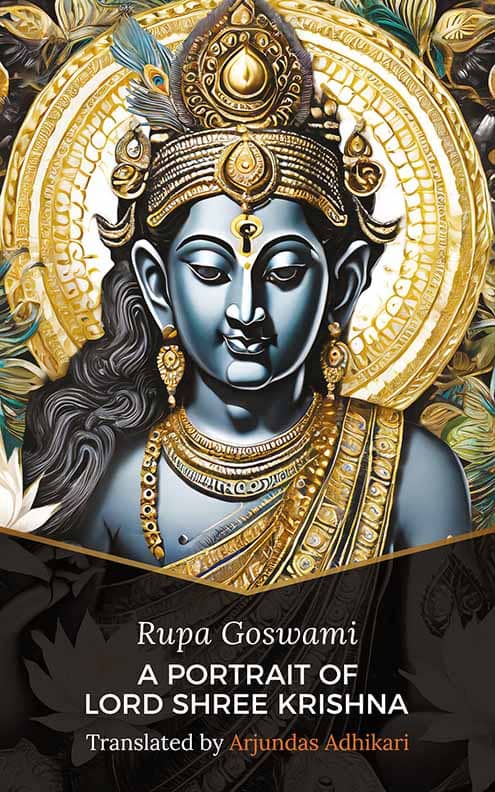
Recently, while completing a new translation of Lalita-Madhava, one of the great 16th-century Sanskrit dramas by Rupa Goswami, I was struck by how contemporary many of its concerns still feel. Beneath the historical and religious setting lie questions that remain recognisably human: the search for fulfilment and the desire to find one’s place within a larger story.
Perhaps that is why sacred narratives continue to reappear in artistic life. They endure because they engage seriously with questions that never disappear, no matter how much the world changes.